I
How to Read an Instrument
One anatomy, nine suites, no hidden syntax
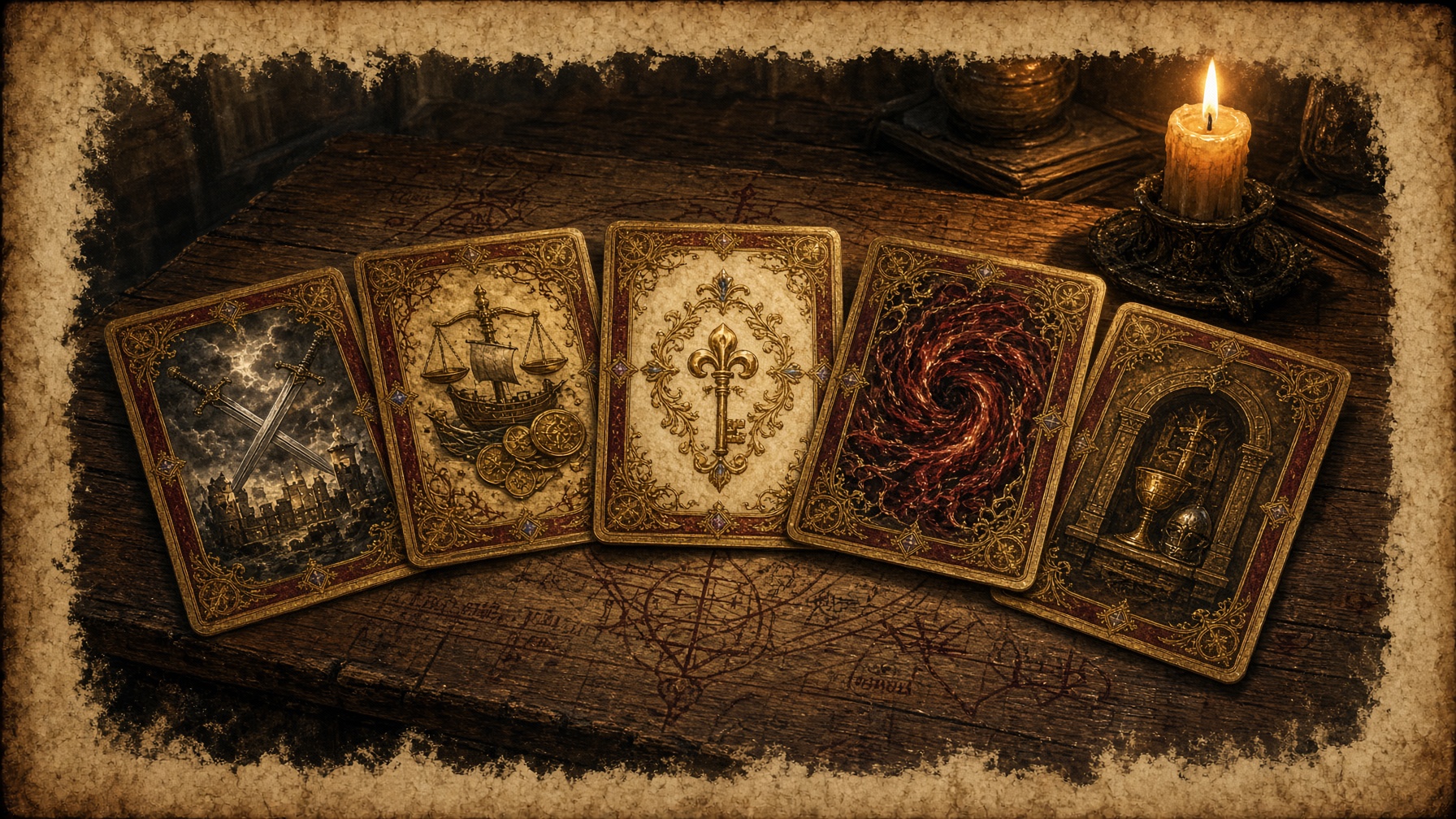
This volume is the Spell Compendium analogue: every written Core card in one place, grouped by suite, with status language left honest. The Player’s Handbook teaches you how a turn feels. The Codex is what is in your hand.
Every card uses the same anatomy. Top-down action rail: Traverse → Command → Gesture, with legal timing highlighted. Left and right cost sockets for Goods, Coin, Order, Influence, Momentum, Clue, and prerequisites. Central instrument field for name, rule, target, range, duration, and values. Bottom UV resonance for blacklight lore or Veiled information.
The 89-card frame
| Range | Suite | Count | Status |
|---|---|---|---|
| 001–004 | Champions | 4 | OPEN / source recovery |
| 005–020 | Cohorts | 16 | OPEN / source recovery |
| 021–032 | Conflict | 12 | ROUGH DRAFT |
| 033–040 | Infrastructure | 8 | V0.2 PROVISIONAL |
| 041–048 | Commerce | 8 | V0.2 PROVISIONAL |
| 049–056 | Diplomacy | 8 | V0.2 PROVISIONAL |
| 057–064 | Chaos | 8 | ROUGH DRAFT |
| 065–071 | Discovery | 7 | ROUGH DRAFT |
| 072–078 | Relics | 7 | ROUGH DRAFT |
| 079–083 | Majors | 5 | ROUGH DRAFT |
| 084–089 | Flex modules | 6 | ROUGH DRAFT |
Card-writing rules you can trust
- Name the timing. If it is a reaction, say to what.
- Name the cost. If there is no cost, print an em dash.
- One effect. A second sentence is allowed only to close a window or name a limit.
- UV is lore or Veiled information. It never hides a mechanical cost.
- Draft cards do not override locked systems. Newest LOCKED item controls.
Print standard: the table must be able to resolve the card without opening another book. The Codex exists so that remains true.
G/A/I numbers on Infrastructure cards are Guard / Armor / Integrity as written in v0.2. Full Integrity damage destroys the structure and adds +1 Chaos.